
7 Stages of Kundalini Awakening: Symptoms at Each Chakra
Updated: Sep 20
Claudiu Bulaceanu, PhD
Most people who search for kundalini awakening stages want to know which one they are in. The honest answer, from 25 years of measuring chakras directly in people from more than 40 countries, is that most of them are at the first stage and have not left it. That is not a criticism. It is the single most useful thing to know before reading the rest of this page.
Kundalini rises through seven chakras, one after the other, and each one it reaches has to clear before the energy can move on. That gives seven stages, and each stage has its own symptoms, its own material to release, and its own place where people get stuck. This article walks through all seven in order, then shows you how to tell where you actually are rather than where you feel you are.
What Kundalini Awakening Is
The Sanskrit traditions describe kundalini as a coiled energy resting at the base of the spine that rises through the chakras once it wakes. From my own research and practice I understand it as the energy of the Earth flowing into and through the human body. The body is built to be a conduit between cosmic energy above and Earth energy below, and kundalini is the Earth-side current of that exchange.
In an ideal system this energy moves freely. In most people it does not, because the central channel is blocked at one chakra or another by beliefs held in the subconscious. Each blockage is a place where kundalini stalls, and each stage described below is the clearing of one of those places.

Why Spiritual Awakening Has to Come First
Kundalini rising is the second half of a longer process. The first half is spiritual awakening, which is the slow work of recognising that there is a soul, that the soul is the deeper identity, and that the beliefs the personality was built from are not the self. That work releases the material blocking the channel. When enough of it is done, kundalini begins to rise on its own, and it meets a system that is ready for it. I have written separately about the stages of spiritual awakening and how they precede what follows here.
Reversing the order, by trying to force kundalini up through a channel that has not been cleared, is the cause of most of the damage I am asked to repair. The energy slams into material that was never released, and what should have been a rising becomes an injury. Spiritual awakening first. Kundalini second. The sequence is not a preference.
The 7 Stages of Kundalini Awakening
Each stage corresponds to one chakra and to one band on the vibration chart I use in practice. The negative column of each band is what surfaces to be cleared at that stage. The positive column is what the same level looks like once it has cleared.
Stage 1: The Root, Where Most People Never Leave
The root chakra holds the fears about survival: physical safety, money, health, ageing, death, and the background question of whether you will be all right. It is also the gate through which Earth energy enters the body. If the root is weak, kundalini cannot build enough charge to begin rising, whatever else is happening higher up.
The majority of spiritually inclined people I read have a root chakra working at five percent of its capacity or less. That is why I say most people are at stage one. They may have vivid experiences at the brow or the crown, and those experiences are real, but they are not kundalini rising. They are activity in the upper chakras with no foundation under it.
What people report at this stage: heat, pressure or a pulsing sensation at the base of the spine and tailbone, sudden anxiety about money or safety that does not match the actual situation, deep tiredness, and old grief or guilt surfacing without an obvious trigger. What clears here is the material of the Ground band: survival fear, material dependency, guilt, grief and the quiet refusal of life itself. What it looks like once cleared is a person who is grounded, self-reliant and no longer running from survival.
Stage 2: The Sacral Centre and the Pull of Other People
Once the root can hold a charge, kundalini reaches the sacral chakra, which governs how you hold the people closest to you and how you handle sexual and creative energy. This is the Attachment band. What surfaces is possessiveness, obsession, anxiety about a relationship, longing for someone, and shame.
What people report: changes in sexual energy in either direction, emotional volatility, sensations in the lower abdomen, and relationship material from years ago coming back with unexpected force. The most common way to get stuck here is to read the energy as being about another person. Someone whose sacral centre is activating will often decide that a particular relationship is the spiritual event, when the event is the activation itself and the relationship is where it happens to be pointing. Once cleared, this level shows up as tenderness, peace, and generosity toward the people who are actually close.
Stage 3: The Solar Plexus, Where Forcing Does Its Damage
The third chakra is the seat of will, and its band is the Will band. What surfaces here is anger, pride, ego, frustration, apathy, fear of being judged, and attachment to material things. What people report is heat in the abdomen, digestive changes, bursts of energy followed by crashes, and anger arriving faster and stronger than it used to.
This is the stage where forced awakenings do their harm, because will is exactly the faculty people use to force. Someone who has been practising aggressive techniques, or demanding the energy rise by sheer effort, hits this level with the same effort and pushes an unprepared system past what it can carry. It is also the stage where spiritual pride takes root, because the person now has enough energy to feel powerful and not yet enough clearing to hold it lightly. Once cleared, the same level is courage, reason, and the determination to keep growing without needing to win.
Stage 4: The Heart, Where the Dark Night Usually Lands
When kundalini reaches the heart, what surfaces is the material of the Heart band: isolation, an inability to forgive, and grudges that may be decades old. People report pressure in the chest, waves of grief with no present cause, unexpected crying, and old relationships returning to mind with a demand to be resolved.
This is the stage where the Dark Night of the Soul most often arrives, because the heart is where the conflict between the rising energy and the old patterns is felt most directly. The way through is the work of forgiveness and release, not the attempt to skip it. Once cleared, the heart is what most people imagine the whole process to be: love, empathy, gratitude, trust and joy that does not depend on circumstances.

Stage 5: The Throat and the End of Pretending
The fifth chakra governs truth and communication, and its band is Integrity. What surfaces is every place where what you say and what you are do not match: hidden agendas, judgements of other people you never voice, the intellectual pride of being right, and the simple habit of not saying what is true.
People report tightness in the throat, changes in the voice, and a growing inability to keep up arrangements built on pretence. Jobs and relationships that require a mask become harder to tolerate, which is why this stage often produces visible changes in someone's outer life. The place people get stuck is the belief that they cannot afford honesty, usually about money or about a relationship. Once cleared, the throat is communication with integrity, mercy, openness, and the ability to hold to a principle when it costs something.
Stage 6: The Third Eye, Which People Mistake for the Finish
The sixth chakra (third eye) is perception, and its band is Wisdom. What surfaces is a lack of trust in your own seeing, the habit of handing decisions to other people, ignorance of the causes behind what happens to you, and attachment to ideas about spirituality in place of the thing itself.
People report pressure in the head, vivid dreams, visions, shifts in how reality looks, and headaches that come and go with no medical explanation. I have written at length about kundalini head pressure because it brings so many people to me. The trap at this stage is to take the experiences as the destination.
Someone who can see clearly but has not yet released the material below the brow builds a spiritual identity out of what they see, and that identity is itself an attachment. Once cleared, this stage is about is acceptance, full compassion, and the higher understanding that knows the causes of things without needing to be told.
Stage 7: The Crown, Which Is Not an Ending
When kundalini reaches the crown, the upper chakras open fully and the shift in consciousness that spiritual awakening began is now carried by the energy itself. The band is Unity. What remains to clear is small: the last attachments, the ones that survived everything below.
People report pressure or tingling at the top of the head, long periods of stillness, a sharp drop in agitation, and a sense of being above material reality while still living in it. This is the state the traditions describe as enlightenment. It is not an ending. Integration continues for the rest of the life, and the person at this stage is usually more occupied with what humanity needs than with their own experience of it.
Kundalini Awakening Symptoms by Stage
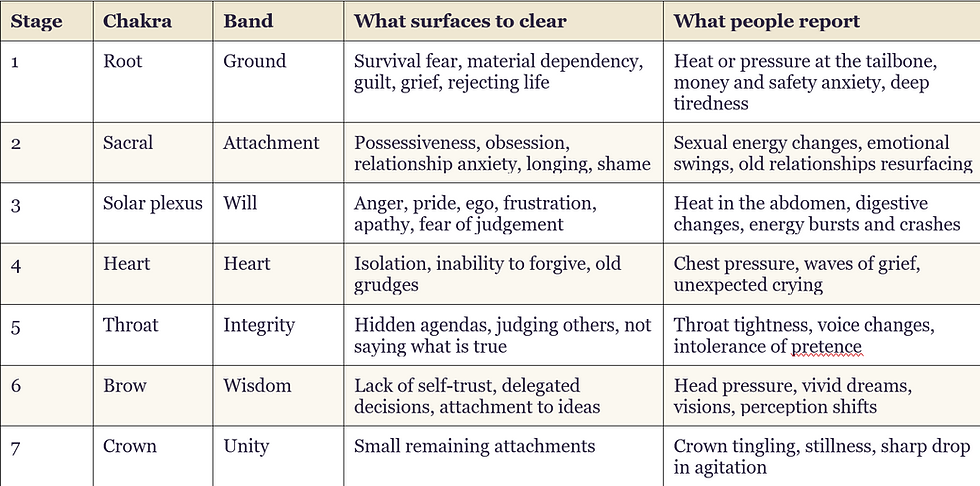
The symptoms overlap between stages, and nobody moves through them cleanly. The kundalini awakening process stalls at whichever chakra still holds resistance and resumes when that resistance releases, which means people cycle back through earlier stages more than once. The pace is set by the readiness of the system, not by the will of the practitioner.
Which Stage Are You In
Self-assessment on this question is unreliable, and I say that having watched hundreds of people do it. Most misjudge their stage by a wide margin, in both directions. Two checks help more than any list of symptoms.
The first is the root. If fear about money, safety or health still decides what you do, you are at stage one, whatever you feel higher up. Experiences at the brow do not move a person past a root that has not cleared. This one check corrects the majority of self-assessments I see.
The second is the difference between feeling material and releasing it. Grief that surfaces at the heart is the stage announcing itself. Grief that has been felt, understood and let go is the stage clearing. Someone can sit in the announcing phase of a stage for years and believe they are further along because the feelings are intense. Intensity is not progress.
If you want the actual measurement, a spiritual reading gives the state of each chakra directly, along with the soul and body vibration and the main beliefs currently holding the process back. It replaces guessing with a number, and the number is usually a surprise.
What Goes Wrong When the Order Is Forced
I see the consequences of forced awakenings regularly in my healing practice: chakras pushed open that cannot close again, energy bodies torn, susceptibility to spirit attachment, severe physical and mental symptoms, and a backlog of beliefs that the rising energy hit and could not move through.
Repairing this takes months and even years, and some of it does not fully repair. The root chakra in particular is the most dangerous one to open by force, because everything above it depends on it.
What does not work is worth stating plainly. Substances like drugs or ayahuasca for instance do not awaken kundalini safely. Aggressive yogic techniques applied without preparation do not awaken it safely. Demanding the energy rise by will does not awaken it safely. The path moves at the pace the system can carry, and trying to outrun that pace is the cause of most of the cases I repair.
What Actually Moves Kundalini Through the Stages
Releasing limiting beliefs is the foundation, and without it nothing else on this list produces more than surface effects. Some of it yields to honest self-inquiry, journaling and meditation. Beliefs that resist self-effort are what limiting beliefs release sessions are for, because they reach what the conscious mind cannot.
Grounding matters more than most teaching admits, and it is the practice most spiritual people skip. Walk on the earth. Spend time in nature without a phone. Eat real food and sleep properly. Work on the survival fears in the subconscious. Without grounding, kundalini has nowhere safe to rise from.
Daily meditation, twenty to thirty minutes, creates the space the process needs.
Breathwork supports the channels the energy moves through. Keeping the chakras in balance as the energy rises prevents the stalls that turn into blockages.
Structured training in a good spiritual school sequences all of this in the right order and gives you feedback on where you actually are, which is the thing self-directed practice cannot provide.
Questions People Ask
What are the first signs of kundalini awakening?
Heat, pressure or pulsing at the base of the spine, together with survival fears surfacing that do not match your actual situation. Tingling in the hands or the head on its own is not a sign of kundalini. It is far more often upper-chakra activity in a person whose root has not cleared.
How long does kundalini awakening take?
Months and years, in the healthy pattern, and it does not run on a schedule. The energy moves when a chakra clears and stalls when it meets resistance. Anyone promising a timeline is describing something other than kundalini.
Is kundalini awakening dangerous?
It is dangerous when forced through a channel that has not been cleared, and I spend a good part of my practice repairing exactly that. In its natural sequence, after the work of spiritual awakening has been done, it is not.
Is kundalini awakening the same as spiritual awakening?
No. Spiritual awakening is the inner work that clears the channel. Kundalini rising is the energy moving through the cleared channel afterwards. The first has to come before the second.
Can kundalini get stuck?
Yes, at any chakra that still holds resistance, and it stays there until the material at that level is released. Stalling is normal. Staying stalled for years is what a reading is for.
What happens when kundalini reaches the crown?
The upper chakras open fully and the shift in consciousness that began with spiritual awakening becomes stable. It is not the end of the process. Integration continues for the rest of the life.
Rule Out Medical Causes First
Several of the sensations described above have ordinary medical causes. Chest pressure and palpitations, tremors, unexplained heat, persistent headaches and back pain all need a physician before anyone attributes them to energy. A medical evaluation and a spiritual assessment are not in competition, and the first one comes first.
If you are experiencing severe disorientation, losing track of what is real, or feeling that you are in danger, contact a qualified professional or an emergency service in your country now. Nothing on this page is medical advice or diagnosis.
Finding Out Where You Actually Are
The seven stages are a map. What the map cannot do is tell you your position on it, and most people who try to work that out alone get it wrong. A reading of the state of each chakra and of your soul and body vibration gives you the position directly, and the beliefs that are holding it.
Where the answer is a belief, which at stage one it almost always is, limiting beliefs release sessions are the work that follows. Both are available through the Body & Soul Ascension Academy. Choosing who to work with matters as much as the work itself, and it is worth reading about how to tell a genuine teacher from a less trustworthy one before committing to anyone.


Comments